
Dolly Parton’s death at age 80 has prompted people around the world to reflect on the music, businesses, and philanthropic programs she built. Her death was confirmed by the Associated Press on August 25, 2026.
Her legacy offers business leaders a broader lesson: lasting organizations rely on shared knowledge, documented systems, and clear plans—not on any single person holding all the answers.
When a critical employee leaves unexpectedly, an IT provider changes hands, or an emergency interrupts normal operations, your company faces a simple test: If someone new had to manage your technology tomorrow, could that person find the information and access needed to keep the business running?
What Is MSP Documentation Ownership?
MSP documentation ownership means your business retains legal control and secure, recoverable access to its domains, cloud tenants, software accounts, network records, backup plans, and other critical IT information. An IT provider may manage those systems, but your company should be able to transfer access without losing operational control.
Many owners do not discover documentation gaps until a transition exposes them. Strong business continuity planning requires knowing where your data lives, who controls each account, and how another authorized person could take over safely.
The Hidden Risk of Undocumented Systems
Small businesses often depend on one internal employee or outside IT contractor for daily technical support. That arrangement may work well for years—until the person who knows the network, vendors, passwords, and recovery procedures is suddenly unavailable.

If an IT provider keeps your network configuration inside tools you cannot access or export from, your company may own the equipment without owning the operational knowledge required to manage it. Switching providers or bringing support in-house can then lead to avoidable downtime, delays, and security gaps.
The answer is not to give every executive unrestricted access to every system. It is to establish secure organizational ownership, named administrative accounts, appropriate client access, and a documented emergency process. Credentials should be protected in an enterprise password manager with multifactor authentication—not shared through spreadsheets, email, or a common master login.
Three Standards for Digital Asset Control
A resilient IT environment rests on three practical standards:
- Centralized, exportable documentation: Your IT partner should organize network diagrams, equipment records, account details, vendor agreements, and operating procedures in a secure documentation platform. Your company should receive appropriate client access or a current, protected export that can be recovered during a transition.
- Version history and regular review: Technology changes quickly. Important records should show who changed them and when, and your provider should review them on a defined schedule so old configurations and contacts do not remain in circulation.
- Organizational account ownership: Domains, cloud tenants, software subscriptions, and other critical services should be registered to the business—not to an employee’s or contractor’s personal account. Providers can receive delegated access through individually named accounts without becoming the legal owner.
The Small-Business IT Documentation Checklist
Use this seven-point checklist to review your current managed IT support. Your authorized leadership team should be able to locate each item when it is needed.
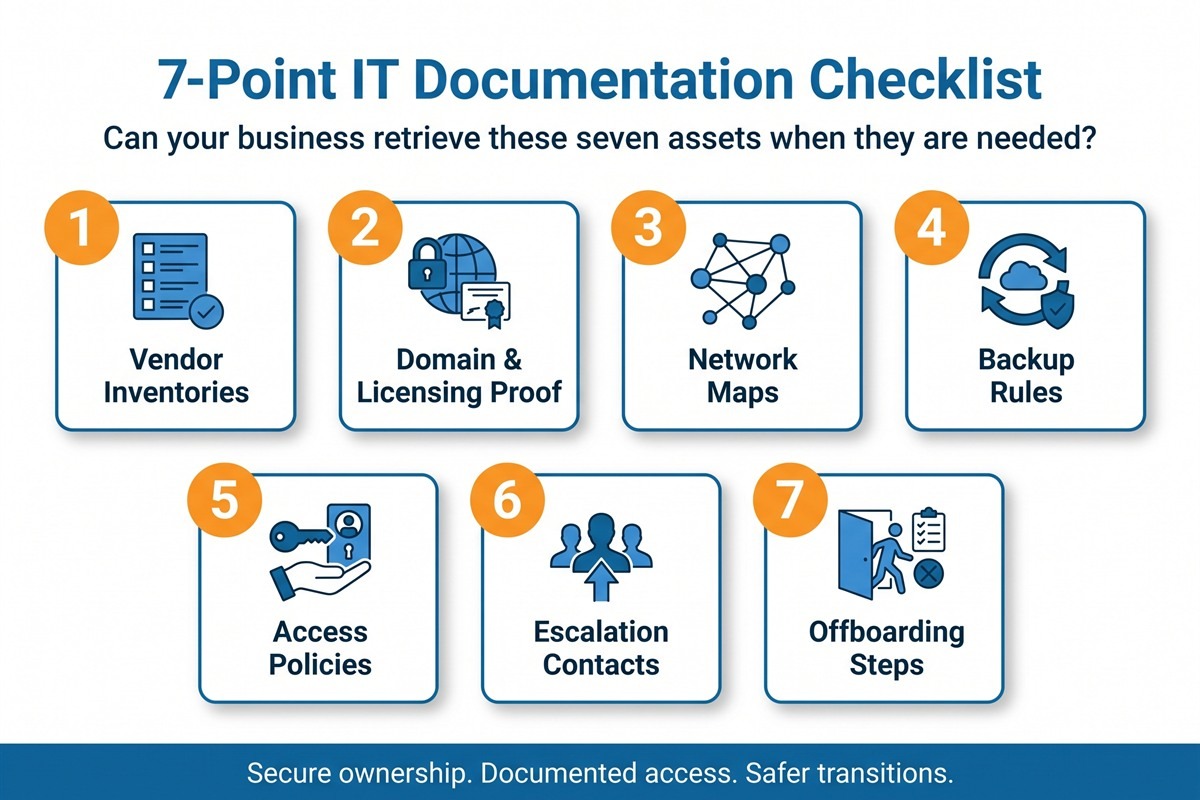
- System and vendor inventory: Maintain a current catalog of computers, servers, network equipment, internet providers, SaaS applications, and service agreements.
- Domain and licensing proof: Keep records showing that the business owns its domain registrations, SSL certificates, cloud tenants, and software licenses.
- Network architecture diagrams: Document physical equipment, internet connections, wireless networks, cloud environments, and important dependencies.
- Backup and recovery procedures: Record backup locations, retention schedules, recovery responsibilities, and the dates and results of documented recovery tests.
- Security and access policies: Define multifactor authentication requirements, user roles, privileged-access rules, and any applicable compliance standards.
- Emergency escalation contacts: Maintain current support numbers, account identifiers, after-hours procedures, and primary contacts for critical vendors.
- Handoff and offboarding procedures: Document how to revoke access, transfer administrative control, export records, and verify that former personnel or providers no longer retain permissions.
Safeguard Your Business Blueprint
You do not need to manage servers every day, but your company should retain control of the accounts, records, and recovery procedures that keep the organization operating. Clear ownership reduces key-person risk, makes provider transitions safer, and helps your team respond faster when normal operations are disrupted.
At Hoola Managed IT, we build client relationships around transparency. We organize systems, document assets, and help clients maintain control of their technology while our local team handles day-to-day management and support.
Ready to find gaps in your IT documentation? Schedule a free IT consultation with Hoola’s Muncie team. We will discuss your current environment, identify documentation and ownership concerns, and recommend practical next steps.